
International Financial Reporting Standards (IFRS 2026): Executive Guide to Compliance, Valuation & Governance

Gulf Euro For Training
Content Management Department

International Financial Reporting Standards (IFRS) are no longer merely technical accounting protocols relegated to finance teams; they represent the universal language of global business. For board members, CFOs, and investment directors across the GCC, Africa, and international markets, IFRS compliance is the prerequisite for corporate valuation, capital allocation, and audit governance.
With continuous amendments by the IASB, executive teams face significant structural shifts in revenue recognition, lease accounting capitalization, and financial instrument impairment modeling.
1. IFRS Standards Architecture & Conceptual Framework
The executive diagram below illustrates the core pillars of modern IFRS reporting standards and their direct impact on corporate balance sheets and profit & loss statements:
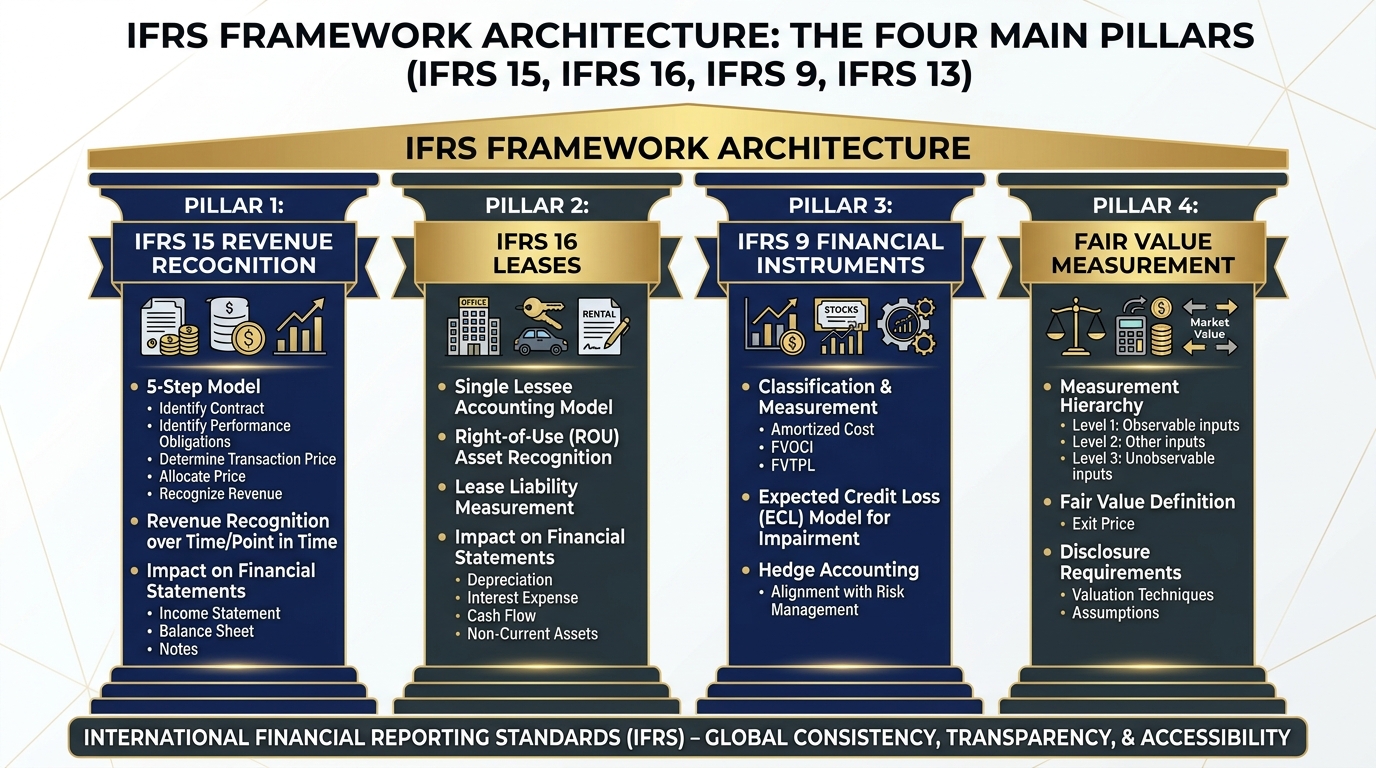
Core Structural Shifts in Key IFRS Standards:
- IFRS 15 (Revenue from Contracts with Customers): Implements the mandatory 5-Step Model transferring control of goods/services rather than simple risk transfer.
- IFRS 16 (Leases): Eliminates off-balance-sheet operating lease accounting, requiring all lessees to capitalize Right-of-Use (ROU) assets and lease liabilities.
- IFRS 9 (Financial Instruments): Replaces incurred loss models with forward-looking Expected Credit Loss (ECL) provisioning.
- IFRS 13 (Fair Value Measurement): Establishes a unified fair value hierarchy (Level 1, Level 2, and Level 3 valuation inputs).
2. Financial Statement Impact of Major IFRS Standards
The executive summary table below highlights key accounting treatments and their financial ratio implications:
| Standard | Core Accounting Shift | Financial Statement & Ratio Impact |
|---|---|---|
| IFRS 16 - Leases | On-balance-sheet recognition of all operating leases. | Increased leverage ratios & higher reported EBITDA. |
| IFRS 9 - Financial Instruments | Forward-looking Expected Credit Loss (ECL) provisioning. | Earlier provisioning reduces unexpected earnings shocks. |
| IFRS 15 - Revenue Recognition | Revenue tied strictly to performance obligation satisfaction. | Adjusts revenue timing in long-term multi-element contracts. |
| IFRS 17 - Insurance Contracts | Current value measurement of future fulfillment cash flows. | Enhanced transparency in insurance company valuations. |
3. Chief Financial Officer & Audit Committee Executive Checklist
Audit committee chairs and CFOs should verify these seven compliance benchmarks prior to financial sign-off:
- 1. Is your Expected Credit Loss (ECL) model calibrated to current macroeconomic forecasts under IFRS 9?
- 2. Are all corporate lease schedules updated and capitalized on-balance-sheet under IFRS 16?
- 3. Does revenue recognition across complex commercial contracts comply strictly with the IFRS 15 5-Step Model?
- 4. What proportion of enterprise assets rely on Level 3 unobservable inputs under IFRS 13 Fair Value?
- 5. Have mandatory asset impairment tests (IAS 36 Impairment of Assets) been conducted for goodwill?
- 6. Is your internal financial reporting aligned with recent IFRIC interpretations and IASB updates?
- 7. Are key members of your finance team certified in IFRS through recognized global bodies (ACCA)?
Advance Your Expertise in IFRS & ACCA Certification
To empower your financial team and prepare executives for global IFRS compliance and ACCA certification, explore our accredited training programs:
💻 Certified Online IFRS & ACCA Exam Preparation Course (1-Week Live Virtual Training)